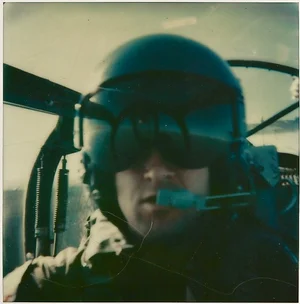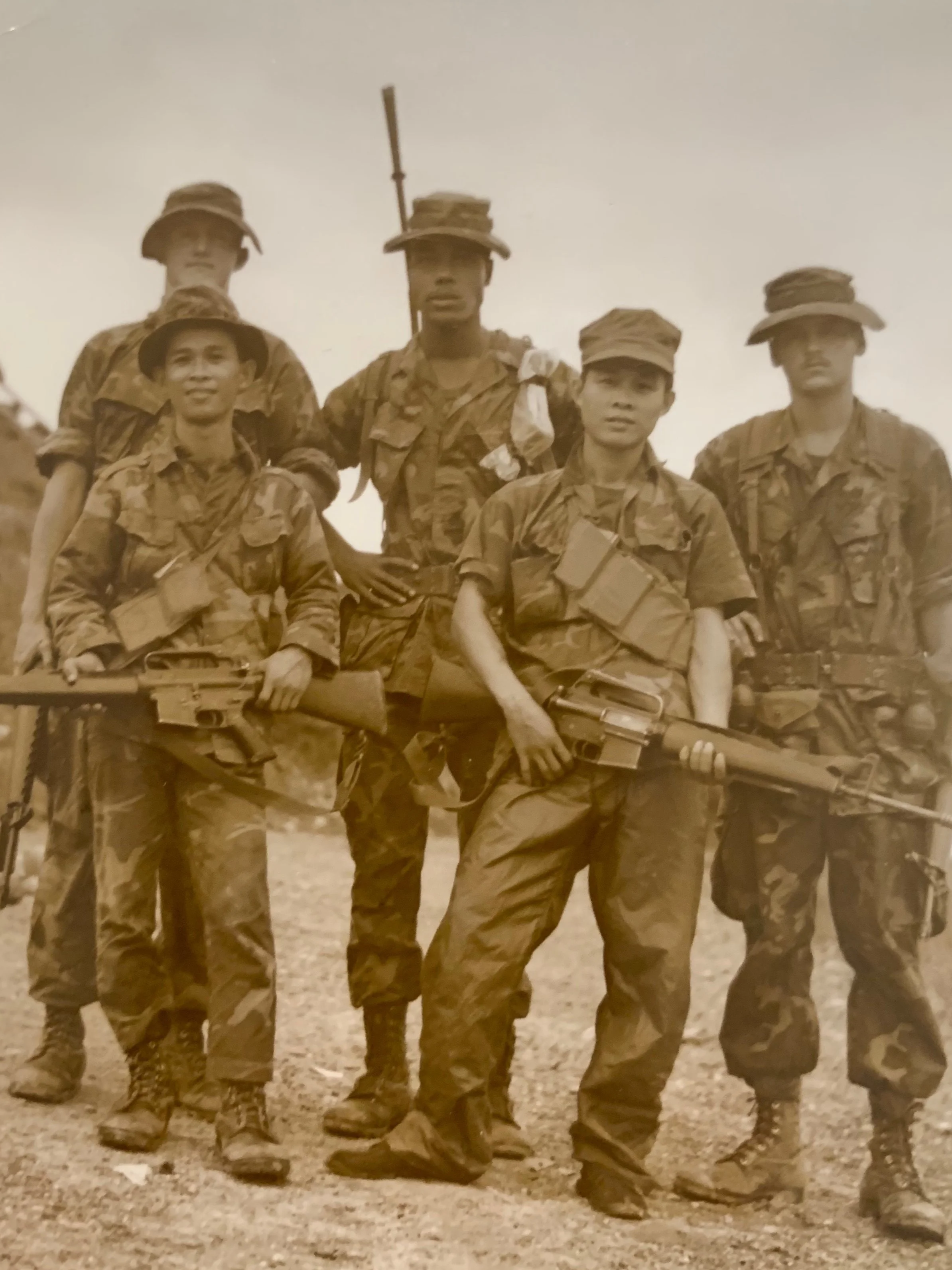
This photograph was taken on Hill 190, 17 miles northwest of Da Nang, in 1970. I was with my scout team, made up of three Marines, and two South Vietnamese scouts.
These two men had been captured by the North Vietnamese Army (NVA) during the 1968 Tet Offensive. Eventually they escaped their captors and became Kit Carson Scouts, a unique tactical program developed by the Marine Corps in Vietnam.
I was a team-leader in the S-2 battalion intelligence section. The Kit Carson Scouts acted as invaluable guides, interpreters and anti-guerrilla forces for the American infantry units.
The Sapper
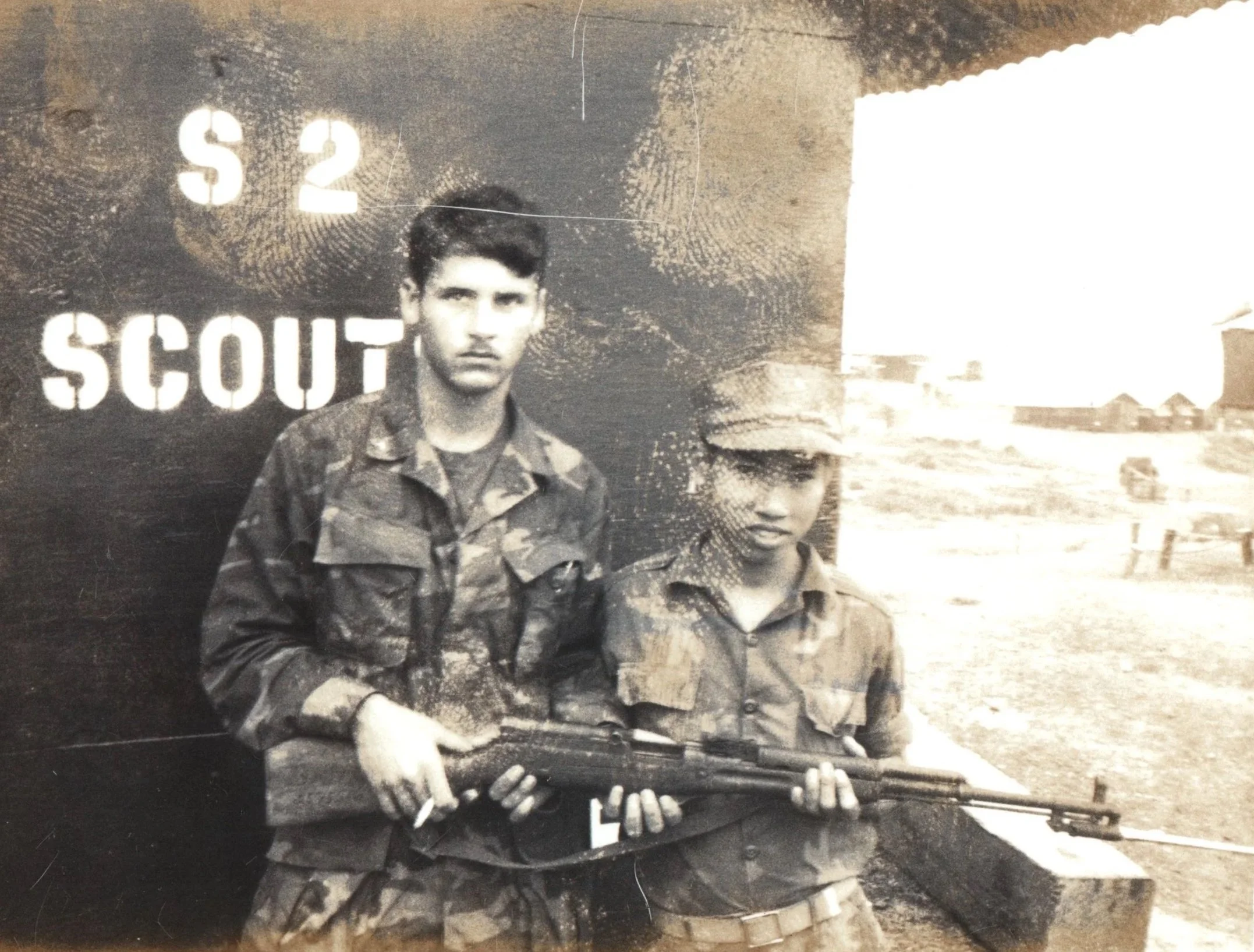
My eyes were fixed on the photograph. I felt as though I was looking into the eyes of two strangers, as though it was from a different life. Time had woven its magic, transforming an experience I thought would stay with me forever into a faint recollection. I was met with the gaze of two strangers. One was a nineteen-year-old Marine scout, holding a cigarette in his right hand and with a hardened expression; the other a young, diminutive, but ominous-looking Vietnamese Kit Carson Scout. Each is gripping a captured enemy SKS semi-automatic carbine, the bayonet unfolded. Then, a dam broke, and everything flooded back.
We were conducting a day patrol close to Hill 190, located 17 miles northwest of Da Nang, accompanying a squad belonging to one of the third battalion’s companies. The season was summer, bringing typical misery: oppressive heat, sticky humidity, and hordes of mosquitoes. My scout’s name was Phong. The word means wind or breeze, yet that’s the furthest description I’d use for him. While searching the riverbank of the Song Cu De River, flowing from the western mountains to Nam O Beach on the coast, a young Marine found the SKS shown in the picture. As members of S-2, the intelligence section, we took the weapon and had it examined. The S-2 would decide if it was possible to return it to the Marine. Before handing it over to S-2, I made sure to snap a trophy picture.
Previously, Phong served as an enemy sapper—a combat engineer and saboteur trained in infiltration. His role with the VC (Viet Cong) was straightforward yet perilous: infiltrating the enemy’s perimeter at night. After defecting from the VC and joining the Kit Carson Scout program, we put his skills to good use. Because of his talent for identifying various booby-traps and subtle enemy signs, he became an essential point man. Signals that I could have overlooked.
I recall a particular event vividly. I brought Phong to several Marine combat bases and had him assess Marine night defensive positions. Stripping down to just his black shorts and sandals, he demonstrated how he silently cut through their concertina wire and bypassed trip-flares.
Phong had, in fact, killed Marines during his time with the other faction. It would be untrue to claim it didn’t bother every Marine. One day, an indignant Marine came up to us and arrogantly informed Phong that he would need to replace any flare he triggered. I realized the loathing Phong inspired in some Marines. I felt it myself occasionally, but then I’d realize that he was showing us how to survive. I utilized that to counteract the emotion. It was clear that Phong was angry at the Marine’s remark, yet I just smiled.
Eventually, Phong completed his penetration. You had to be impressed by his snake-like movements beneath and around the obstacle. He walked up to the arrogant Marine with a look of contempt and threw down the disassembled trip-flare. Grinning at the bewildered Marine, I turned around and trailed behind Phong, whose body was marked with cuts and scratches. Offering him my congratulations, I took him to sickbay.
That’s the tale behind the picture. One last thing: I valued Phong’s skills, but I never had full trust in him. I likely never completely trusted any of my Kit Carson Scouts. At nineteen years old, the war had bred a profound suspicion in me towards anyone or anything that could endanger my life. It’s likely the reason I stayed alive. I believe the lack of trust is visible on both our faces.
After my war tour I never heard what became of Phong. I never cared, until recently, when that photograph transfixed me.